
Reno City Directory Sources
Historical directory research in Reno starts with several collections that overlap without forming one seamless run. UNR digitized early directories for Reno, Sparks, and nearby communities beginning in 1900. Downtown Reno Library keeps local city and telephone directories in its local-history collection, while the Reno historic-property research guide points to Polk volumes for 1900 through 1939 online and later or other runs in physical library holdings. A directory title page has not been inspected for every volume, so publisher names and a complete year-by-year inventory should be taken from the actual book rather than assumed.
| Collection | Years | Where Held | Access |
|---|---|---|---|
| UNR early Reno-area directories | Beginning 1900 | UNR Digital Special Collections | Digitized collection; confirm current host access |
| Polk directories | 1900-1939 | Historic-property guide route | Online |
| Local city and telephone directories | Years vary by volume | Downtown Reno Library | Local-history collection and staff research route |
| Phone books and related runs | From the 1920s onward | Downtown Reno Library and Nevada Historical Society | Physical collections |
A missing online result is not a missing record. The UNR collection host denied access during research, and many local runs remain a shelf, microfilm, or staff-assisted task. For a specific volume, write down the year, title, and page before drawing a conclusion from it.
Reno Directories Start in 1900
UNR's account of its early directory project confirms that the digitized Reno-area series begins in 1900 and includes Sparks and other nearby places. The collections can show names and addresses, with some years also carrying occupations or listings for institutions such as clubs, churches, schools, cemeteries, and hospitals. Those categories are useful leads, but each book has its own scope.
Keep place names separate. A directory from Reno may actually belong to Sparks or an unincorporated Washoe County community included in a regional volume. Match the printed address with the community label and then check the period's map or newspaper. That small geography check prevents a modern city boundary from being imposed on an older listing.
Note: The collection's early start is verified, but a publisher and page-level entry should be confirmed from the selected volume.
Reno Library Directory Shelves
Washoe County Library genealogy resources identify Downtown Reno Library as a practical local-history stop for local directories, telephone books, clipping files, and complete Reno newspaper microfilm. Its Nevada files hold thousands of local history articles. The library can also accept a directory research message at 775-327-8312 when staff service is available; provide contact information, names, date ranges, address details, and spelling variants.
The local-history room matters when a search is tied to a house or family rather than a single online record. Researchers can move from a directory year to a phone book, a newspaper reel, or a clipping file without pretending those materials are one database. The Reno Family History Center, at 4751 Neil Road, is another in-person fallback for microfilm, microfiche, print sources, subscriptions, and volunteer help. Confirm its schedule and equipment before visiting.
The library's genealogy page introduces the local directories and newspaper resources shown here.
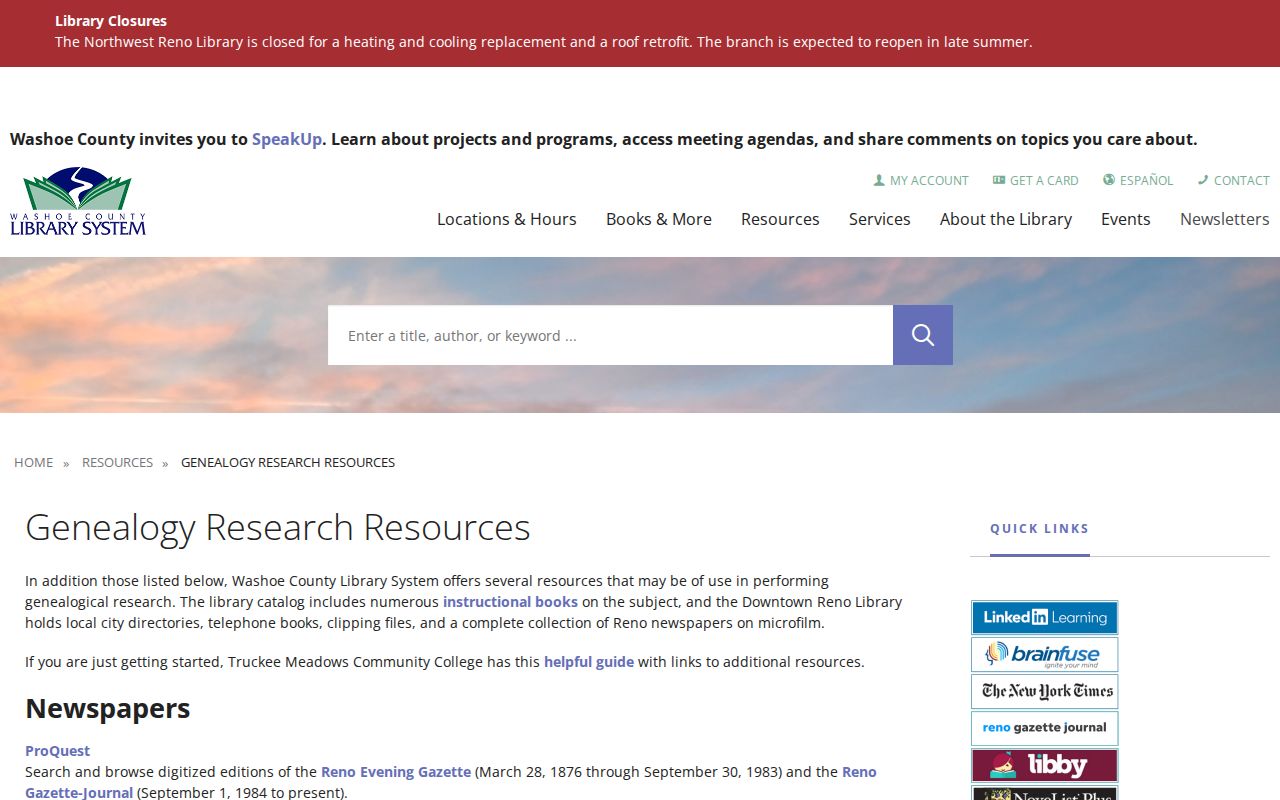
That library route is especially useful when the spelling, street name, or date needs to be checked across more than one local source.
Reading Reno City Directory Entries
A directory entry from Reno should be transcribed, not expanded into facts the volume does not state. The research verifies an alphabetical name-and-address arrangement and says that some volumes may include occupation, spouse, business, or community details. Reverse or address sections may be separate. The individual pages could not be inspected through the digitized host, so no universal symbol, owner mark, or sample person is claimed here.
| Name | Record the surname, given name, initials, and spelling exactly as printed. |
|---|---|
| Address | Copy the street number and street form, including any directional or abbreviated wording. |
| Occupation or business | Use it only when the selected volume actually includes it. |
| Spouse or household clue | Note it as printed when present; it is not confirmed in every volume. |
| Reverse section | Check for one only if that year's directory includes an address-order portion. |
- Criss-cross directory
- An address-order directory that can place listed names along a street when that particular volume has such a section.
- Householder index
- An index organized around a household or address rather than a standard surname sequence.
- Abbreviation key
- The guide near the front of a volume that explains its own shortened words and marks; read it before interpreting an entry.
Note: Photograph or transcribe the abbreviation key for each year because directory conventions can change between volumes.
Reno Directories Beyond City Limits
Historical directory coverage is regional in places. UNR describes its early set as covering Reno, Sparks, and surrounding communities, while Reno's present record geography can also cross city limits, annexations, and Washoe County territory. A postal label alone does not settle which jurisdiction held a record at the time. Use the address printed in the directory as a starting point, then compare it with the relevant period's map, parcel history, or local newspaper.
This is helpful for family research around the Truckee Meadows. A move may look like a city change even when a nearby community was included in the same publication. It may also look like a gap if the next volume used a different geographic heading. Save the volume title with the entry so the coverage decision remains visible.
Reno Newspapers Around Directory Years
Newspapers can bracket a directory appearance with dated notices, but the title and date range matter. The library's archive material identifies Nevada State Journal from 1870 to 1983, Reno Evening Gazette from 1876 to 1983, and Reno Gazette-Journal from 1983 forward, with overlap at the transition. The genealogy resources also describe Evening Gazette coverage from March 28, 1876 through September 30, 1983 and Reno Gazette-Journal coverage from September 1, 1984 forward in ProQuest.
Search the name, street, neighborhood, and alternate street forms. The library's obituary index is a staff-side catalog that covers roughly mid-1962 through September 2007. An advanced subject search can provide a date and page for microfilm; ProQuest Reno Gazette-Journal obituaries extend from 1999 to the present. The obituary index does not include the Sparks Tribune.
Note: When newspaper dates overlap or differ by guide, check the reel label and the newspaper title before recording a gap.
Tracing Families in Reno City Directories
City directories can help reconstruct a household when used as a series of dated observations. Begin close to a known family event, then look at the previous and next available volume. An address change, first appearance, or last appearance documents what that directory recorded, not an exact move date. Pair entries with deeds, parcel history, newspaper notices, and census schedules when those sources are available.
- Choose a year bracket and write down each surname, initial, address, and street spelling found.
- Check the nearest earlier and later directory volumes, preserving the exact year of every observation.
- Use the reverse section and abbreviation key if the volume supplies them, then compare nearby addresses.
- Pair directory years with available census schedules and dated newspaper notices to test a household pattern.
- Use the library obituary index or ProQuest period when a later death notice may close the timeline.
A deed may identify a recorded interest while a directory may identify an occupant or business address. Neither record proves every person who was present. For a modern address-keyed search, use the Reno street directory lookup after the historical entry has supplied a concrete address.
Reno Yearbooks as Name Checks
UNR Artemisia yearbooks offer another dated name layer from 1899 through 2008. Listed gaps are 1895-1898, 1906-1907, 1909-1912, 1915-1916, and 2000. Search by name or keyword where the viewer permits it, and log both a match and an absent issue rather than treating the run as complete.
A yearbook can support a connection to the University of Nevada through a name, club, campus role, or photograph. It does not establish a permanent Reno residence. The best use is to compare its date and spelling with a directory entry, then return to local newspapers or directories for an address-level lead.
Note: A student listing shows an institutional connection, not a verified long-term residence at a Reno address.
Reno Historical Society Indexes
Nevada Historical Society Research Library adds records that city-directory volumes do not provide: newspapers, maps, government documents, subject files, manuscripts, periodicals, rare print files, and more than 500,000 photographs. Its on-site indexes include Territorial Enterprise for 1859-1891, Nevada Teachers Cards from 1860, a history index organized around people, places, and things, and more than 2,000 clipping folders. Workstations have newspaper and genealogy subscriptions.
The library is at 1650 N. Virginia Street, Reno, and its current notice says it is closed to the public for renovations. Call 775-688-1190 to verify reopening and copying rules. Some material is fragile or deed-restricted, so access may require staff assistance or limit copying. These are useful archive paths when a Reno city directory entry needs context, not a replacement for the directory itself.
The Historical Society research library outlines the archive holdings and its current renovation notice.
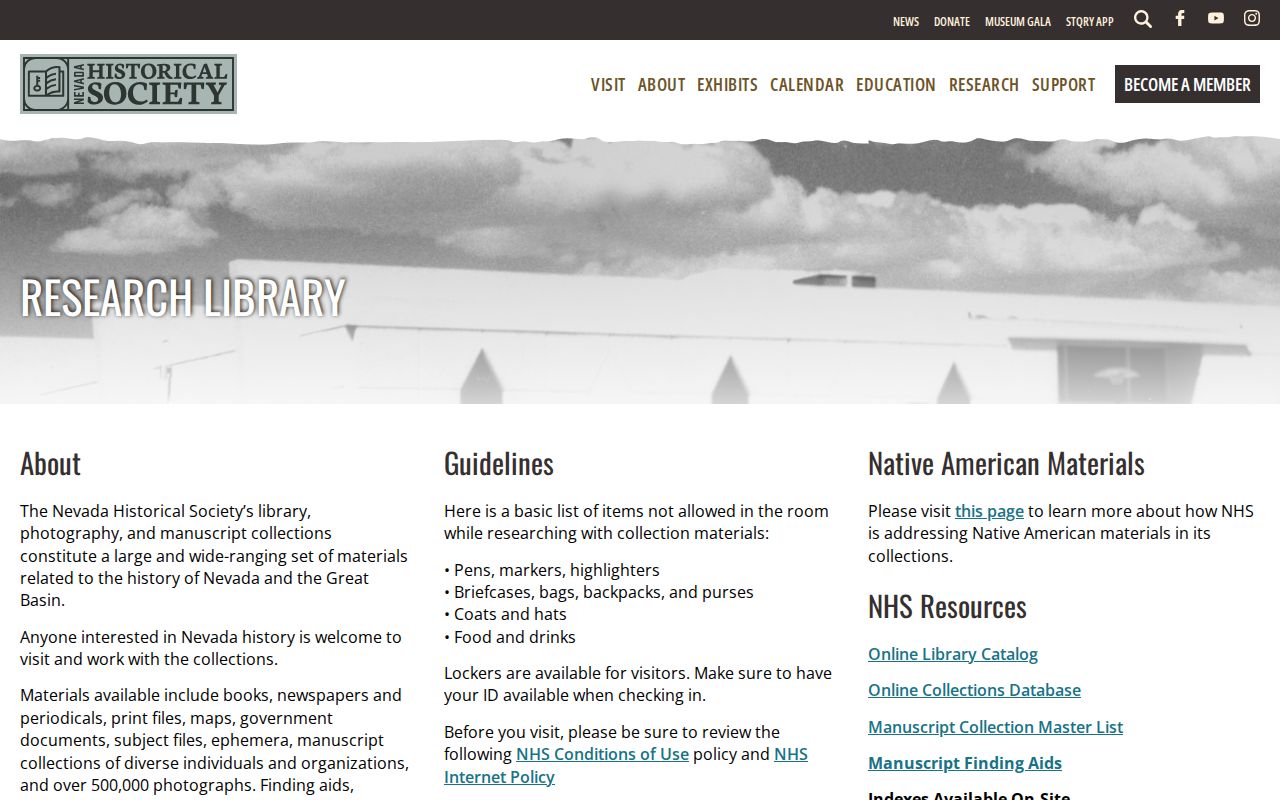
Its card indexes, clippings, maps, and newspapers can help explain a place or family name found in an older directory.
Reno Library Collections Moved
Reno's library history explains why directory research often follows the collection rather than one old building. The first public library opened in 1904 after a $15,000 Carnegie grant. Its collection moved in 1930, and the original building was demolished in 1931. Today's Downtown Reno Library is therefore part of a longer chain of local stewardship, alongside UNR and the Nevada Historical Society.
That history is a reminder to look across the local archive stack when one shelf has a gap. Record which institution supplied each item and return to the custodian when the original volume, image, or copy matters.