
Reno Resident Lookup Records
A person can appear in several Reno systems for different reasons. The Washoe County Assessor CAMA search ties an owner or trustee to a tax parcel, while the court index captures a case event. A marriage index can point to a county record. A credential board can confirm a license. None of those facts alone establishes where someone lives now. Use the source that answers the exact question, save the date of the result, and compare at least two independent fields before treating names as a likely match.
| Record | What It Can Confirm | Reno-Area Custodian | Access Route |
|---|---|---|---|
| Parcel assessment | Owner or trustee, situs, APN, recorded-sale clues | Washoe County Assessor | Public CAMA search, counter, phone |
| Case docket | Case number, party name, filed date, events | Second Judicial District Court | Public search, terminals, copy request |
| Registration status | Civic-registration status under portal rules | Washoe Registrar and Nevada SOS | Official lookup or statutory voter-list route |
| Vital event | Eligible certificate, verification, or genealogy search | Nevada Vital Records and Washoe Health | Qualified request, appointment, mail, phone |
| Credential or filing | License status or business-record connection | Nevada board or Washoe Clerk | Primary agency lookup or records request |
For a location-based lead, begin with a street or APN in CAMA and keep the situs address separate from the owner mailing address. For an event or legal lead, begin with the court case search. For family history, a dated directory, obituary, marriage route, or vital-record eligibility route is usually more useful than a current portal. A dated connection is stronger than a collection of unrelated search results.
Reno Resident Lookup Court Fields
The public Second Judicial District Court search form requires at least one identifying field: Case Number, Case Name, Party Last Name, Company Name, or Cross Reference Number. It also uses a math CAPTCHA. A surname is a sensible opening when a case number is not known, then a first name, filed range, or department can narrow the list. The form supports comparison operators, including contains and soundex, so alternate spellings can be tested without declaring a name-only result to be a positive identity.
| Visible field | How the public form handles it |
|---|---|
| Case Number | Text with equals, contains, soundex, blank, and related operator choices; use the court-format number when known. |
| Case Name | Text with the same operator family; the court specifically notes that a partial case name can help. |
| Filed | Date or range with quick choices from single-day and weekly ranges through month, quarter, year, and last 12 months. |
| Party Last and First Name | Separate text fields with comparison operators and null variants. Start with the surname, then narrow. |
| Company Name | Party-name field with the same operator family; a company may be a party to a case. |
| Department | Multi-select field for Delinquency, Dependency, Domestic Violence, Probate, UIFSA, Arbitration, and Departments 1 through 16. |
| Cross Reference Number | Text field with the same comparison and null-variant choices. |
| CAPTCHA and Search | Answer the displayed arithmetic challenge, then submit the query. |
The public court form is shown in this captured Reno court-search screen.
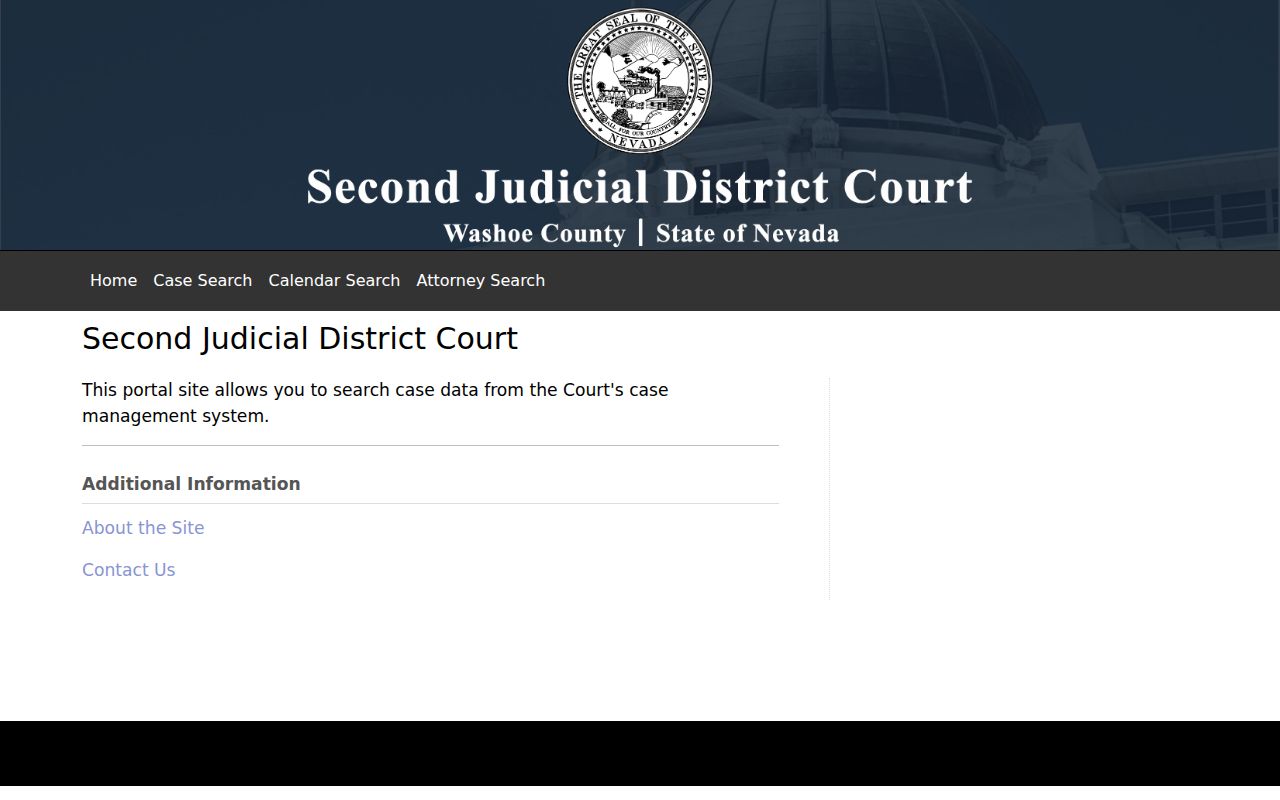
Its separate party, date, department, and reference controls make it possible to narrow a common name without assuming that a docket establishes present residence.
Reading Reno Court Records
After a result appears, select the blue case number. Expand Event Information for hearings and events, then Docket Entry Information for filed-document descriptions and dates. Those panels are a docket and event index, not a complete online court file. A party name should be compared with the party role, case number, filed date, and other non-sensitive context before it is linked to another record.
| Result element | What it supplies |
|---|---|
| Case name and parties | The case caption and party-name context available after opening a case. |
| Case number and cross reference | Identifiers that can anchor a request or separate similar names. |
| Filed and event dates | Timing for the case, hearings, and listed events. |
| Docket entries | Descriptions and dates for listed filings, not a promise that every image is online. |
Complete documents may require the public terminals at the Law Library, 75 Court Street, Room 101, or the Resource Center at One South Sierra Street, third floor. The court also provides a written records-search request form; it states a prepaid fee of $0.50 per name per year. A sealed or protected item may not appear in the public result.
Note: A court docket confirms a recorded case relationship, not identity beyond the record or a current address.
Verify a Reno Resident in Two Sources
Use a short verification ladder. Pair sources that describe different things, such as a parcel and a dated court event, or a directory entry and an official marriage-copy route. Write down the exact spelling, date range, and source URL as you go. The Washoe Recorder uses the name order “last name space first name,” with no comma. Name variants may also include initials, middle names, former names, and a court portal soundex search.
- Record the full name, approximate year, and one non-sensitive detail such as a street, parcel, court number, or directory year.
- Use CAMA or WRMS for a parcel lead, and keep its owner, mailing, and situs fields distinct.
- Search the court form by party name and a useful filed range, or use the Clerk and Recorder route for a marriage lead.
- Confirm the likely match through a second source with a shared address-year, party role-case number, credential number, or documented historical event.
- Request the primary record from its custodian if a copy or official verification is needed.
- Docket
- A court’s chronological list of case events and listed filings.
- Index versus image
- An index helps locate a record; an image or original copy is the underlying document and can have different access rules.
- Certified copy
- A custodian-issued copy bearing the certification required for official use, where the custodian can provide one.
Reno Resident Lookup Vital Rules
Nevada Office of Vital Records is the legal custodian for birth and death certificates from July 1, 1911 forward. Ordinary birth and death certificates are confidential. Nevada law generally limits requests to the registrant, eligible direct family, a guardian, legal representative, or another person with the required direct or tangible interest. Pre-1911 material is normally a county question, so an older Reno lead may instead require the Washoe Recorder, Clerk, library, or archive.
The Nevada vital-records page provides the access and ordering routes shown here.
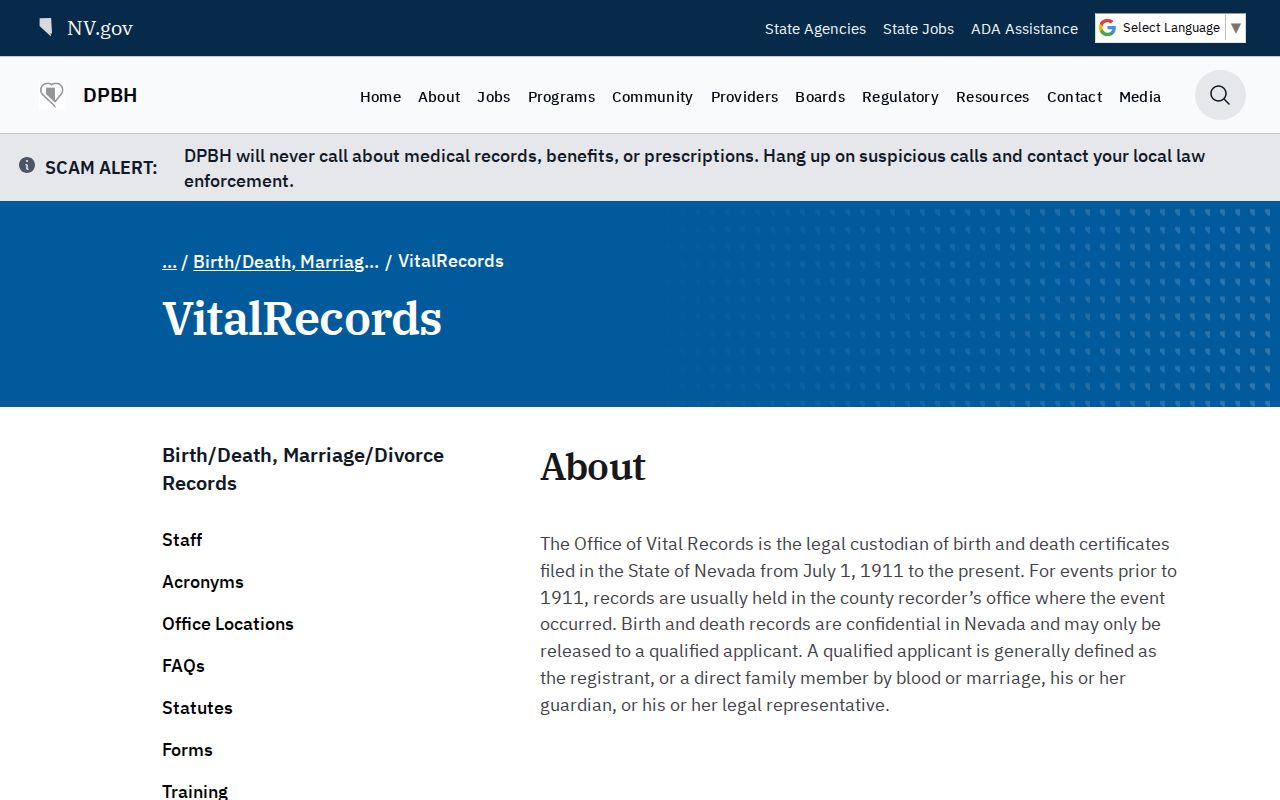
State information lists online, phone, mail, and onsite routes, while Washoe County Health District can provide local issuance or service for locally filed records. A genealogical search is a separate paid appointment service. A vital index is not an address source, and an eligible certificate request is not a general name search.
For marriage, start with the Washoe County Clerk marriage search for an application lead and use the Recorder for a certificate or copy route. Nevada can provide limited marriage or divorce verification for the period from 1968 through September 2005. That verification is a distinct product from a current-person search.
Reno Resident Lookup Family History
For family history, a dated local source can separate people who share a name. The Washoe County Library genealogy resources include local city and telephone directories, newspaper microfilm, and an obituary-index route. The library’s concrete obituary method is to search a deceased person as a subject with advanced search, note the date and page, then consult microfilm. Its obituary index runs roughly from mid-1962 through September 2007, while ProQuest Reno Gazette Journal obituaries extend from 1999 forward.
UNR’s early directory collection begins in 1900 and includes Reno, Sparks, and nearby communities. A directory address, obituary date, yearbook entry, vital-record eligibility route, and court or Recorder event can be compared as dated snapshots. They can help reconstruct a historical household or identify an heir through lawful probate research, but they do not provide an exact move date or establish a current address. Record each year and source separately before requesting the primary document.
Note: A historical directory or obituary is a dated lead, so compare it with a second source before linking it to a modern record.
Reno Voter Status Limits
The Nevada Secretary of State voter search, linked by Washoe County, is designed to check registration information. Archived official field material identifies first name, last name, date of birth, an optional identifier alternative, CAPTCHA, and Search Records. The current tool is dynamic, so use the live official form and do not enter personal details anywhere else. Registration status is civic information, not proof that a person occupies an address.
Review the Nevada voter lookup before using its secure search controls.
The state search is separate from the Nevada registration portal, which is another official access point.
Under the Washoe confidential-voter rules, a voter may have a residential address and phone suppressed while the name, party, and whether the person voted remain visible. A protected-address participant can have substitute-address and status protection. A blank address may therefore reflect a legal safeguard rather than an error.
Reno Credential Record Limits
Official professional and business sources can help distinguish identical names, but they are not household records. The Nevada Real Estate Division lookup searches by name or license number and can show a license number, profession, status, and credential dates. Washoe County’s DBA/FFN search covers filings in Washoe County only. The Nevada Secretary of State and the relevant licensing board are the proper next sources when a filing is outside that county or a different profession is involved.
These records can establish a credential or filing connection. They cannot establish a current home address, cover every profession, or make a common-name result conclusive. The same caution applies to city minutes, public notices, and appointment records: they can document a civic appearance but do not create a resident roll.
Requesting Reno Primary Copies
When a summary matters, ask the source office for the record it keeps. The court offers its terminal, Resource Center, and written-request route. The Recorder can provide document copies after an index lead. Vital-record access turns on eligibility and identification. The City Clerk’s search is useful for records already available under retention schedules, while its request portal is the route for material that needs review, exemption analysis, or redaction.
The Reno City public-records search shows the city’s direct search and request path.
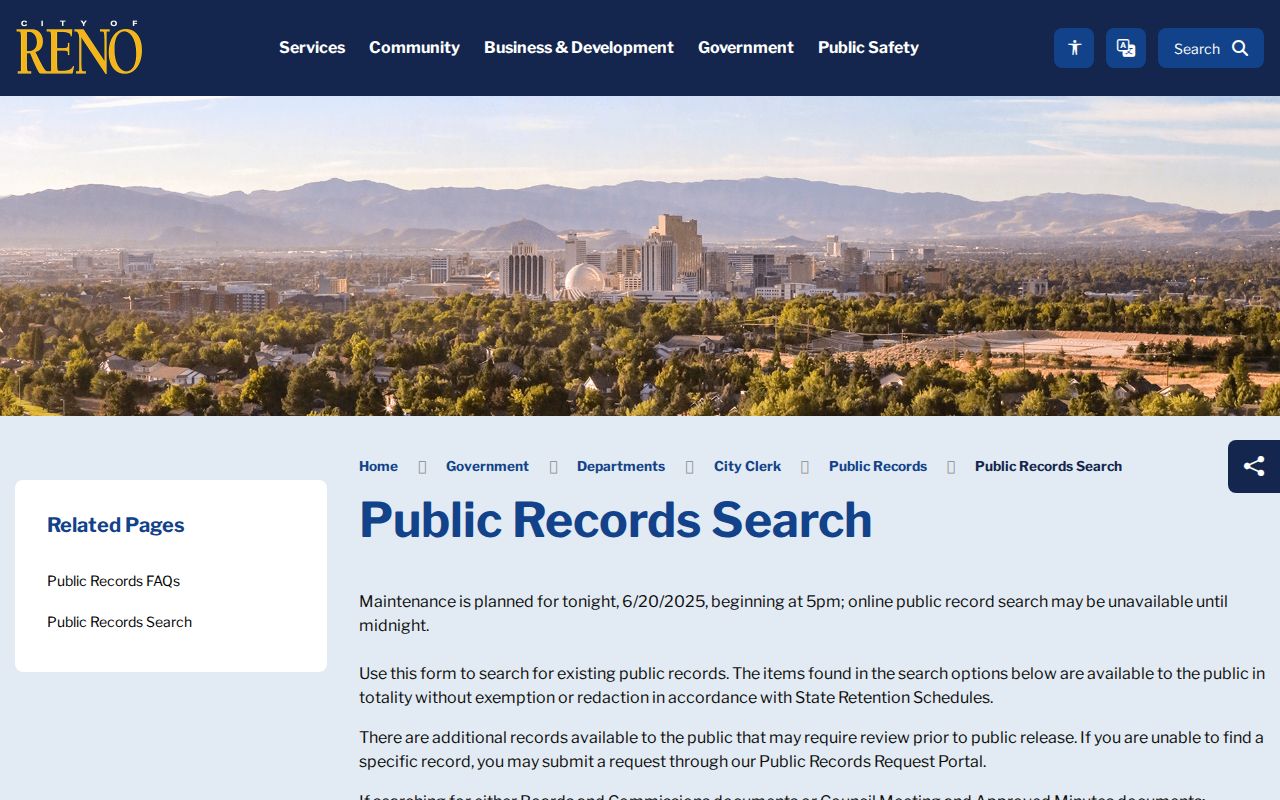
For a request under the Nevada Public Records Act, identify the department, record type, date range, and any case number or APN. NRS 239.0107 generally calls for a response by the end of the fifth business day, subject to exemptions and the custodian’s actual records.
Reno Resident Lookup Privacy Limits
Nevada public access is record-specific. NRS Chapter 239 starts the request process, but a more specific confidentiality law controls when one applies. Birth and death certificates have their own access rules under NRS Chapter 440. Court matters may be sealed or protected. The Recorder allows public index searching but requires an account for recorded-document images. DMV personal information has separate legal limits. A missing search result can reflect a different custodian, an online cutoff, a name variation, a login barrier, or a protected record.
Do not copy or republish sensitive details from forms or records. Use an official source link, ask the custodian about correction, redaction, or sealing procedures when appropriate, and keep protected-address safeguards intact. For a historical address trail rather than a single person, the Reno street directory has the fuller parcel and street workflow.
Lawful use. Use Reno records for personal, lawful research such as family history, estate questions, civic transparency, or checking your own information. Never use a record to stalk, harass, intimidate, or expose a protected address.