
Reno Previous Resident Sources
The best starting source depends on the era. Current parcel data supplies an APN and transfer leads. The Washoe County Recorder holds the official instrument trail, but its public web index begins later than the county's paper records. City directories and newspapers give household snapshots, while marriage records can sometimes provide a dated family-history lead. Keep the source type distinct from the conclusion. A deed owner is not automatically every person who lived at the address, and a directory listing does not fix an exact arrival or departure date.
| Source | Years It Covers | Where Held | What It Shows |
|---|---|---|---|
| Recorder real-estate index | November 1991-current | Washoe County Recorder online index | Principal parties, year, document type, and recording leads |
| Recorder document images | August 16, 1999-current | Recorder image route | Linked document image after login |
| Earlier property records | Before November 1991 | Recorder books, microfiche, counter, or request route | Older deed-chain material |
| Reno-area directories | Beginning 1900 for UNR early set | UNR and local library collections | Dated address and household clues |
| Local newspapers and obituary index | Title-specific runs; obituary index roughly mid-1962-September 2007 | Downtown Reno Library and ProQuest | Dated notices, page references, and context |
For a continuous trail, begin with the address and APN, then carry the party names into the Recorder index. Once the official chain reaches a paper-era boundary, shift to the counter or request channel and use library materials to bridge the dates. This makes gaps visible instead of quietly filling them with guesswork.
Reno Address Records and APNs
Washoe County Assessor CAMA is the practical first stop for a Reno address. Search by situs or address to identify the APN, then record the displayed owner or trustee, last document date, and sales or transfer row. The card separates the situs address from an owner mailing address. It can also show a prior APN, parcel references, and sale fields such as grantor, grantee, document number, document type, and document date.
That distinction matters for address-history research. Assessment data is a public assessment summary, not an occupancy roll. A trust, estate, business, or care-of line may appear as the owner field, and a mailing address can be elsewhere. Call the Assessor with an APN or address question at 775-328-2277, or use the county counter at 1001 E. Ninth Street when a parcel detail needs confirmation.
Before following a past address, note whether the card lists a prior APN or whether the street form has changed. Those details can explain why a name trail seems to stop even though the parcel continues under another identifier.
Reno Recorder Records by Year
Washoe County Recorder search indexes real-estate records from November 1991 to the present, and images run from August 16, 1999 to the present. The public index does not search by street address, legal description, or APN. It works from a principal party name and an approximate recording year. The county's stated format is last name, space, first name, with no comma. Use the CAMA sale row to supply the party and year before attempting a backward search.
The Recorder's grantor-grantee index is the official search surface for the party-and-year method.
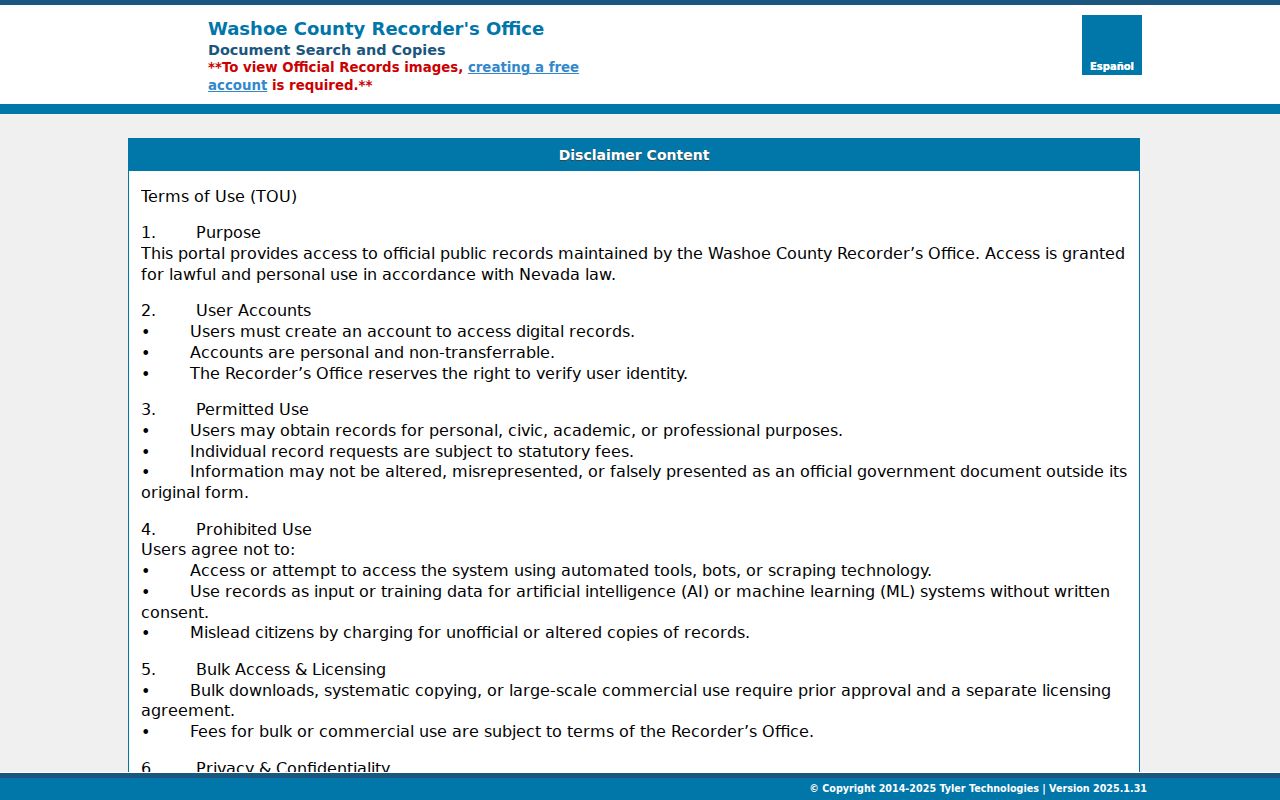
Its result is a deed-chain lead, not a list of everyone who occupied the Reno address.
For older material, ask the Recorder for the relevant book or microfiche series or inspect records at the counter. The office does not perform a generalized search, so provide a name and approximate date. Counter service is at 1001 E. Ninth Street, Building A; requests may also use phone, mail, email, or fax through the Recorder's official contact routes. A document number or book and page will make a copy request more precise.
The Recorder's document privacy explanation describes the public-index and image-login boundary.
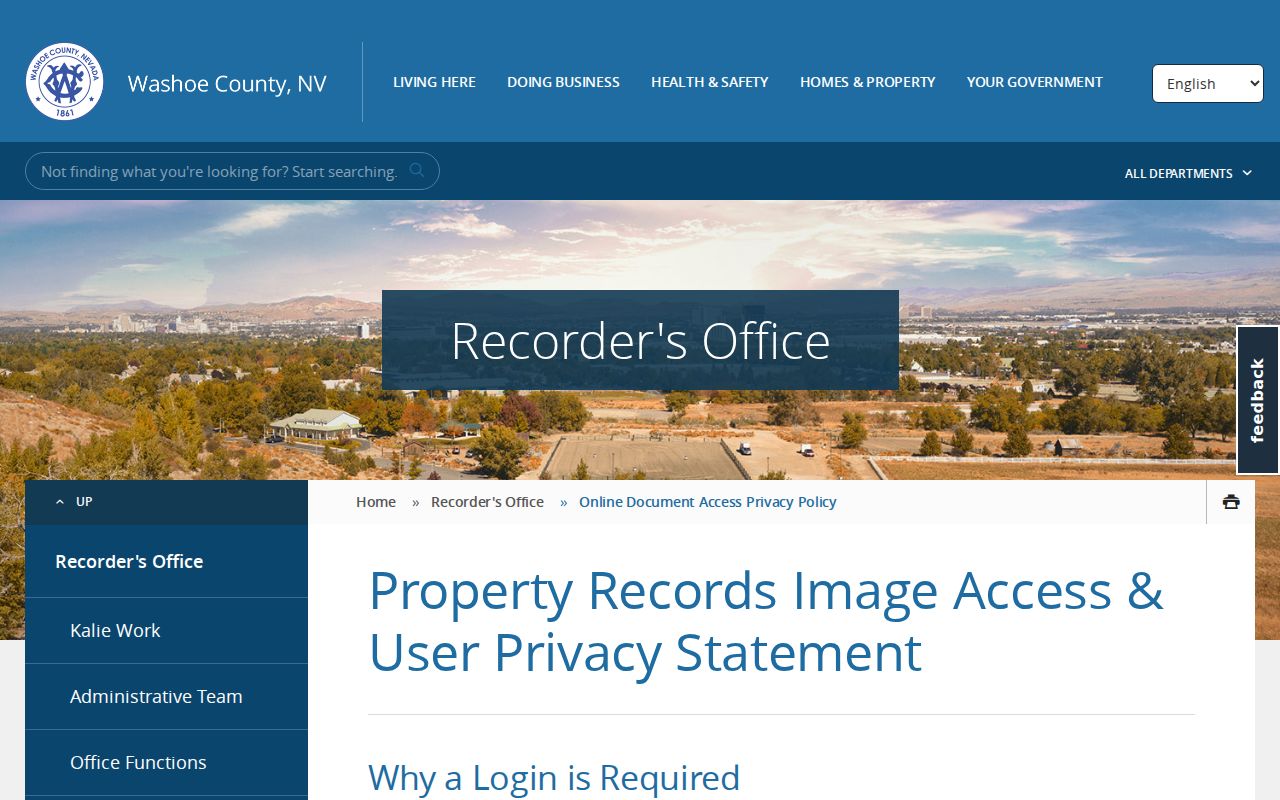
Login for an image does not change the index date range or turn the index into an address search.
Reno Deed Chain for Past Owners
A recorded deed chain runs backward through transfers of an interest in a parcel. Use the current CAMA sales row as the first bridge from a physical address to a party search. Record the people or entities in the order shown and preserve the document number, type, date, and legal description. A legal description remains useful if an old street number changes or the parcel later splits or merges.
- Search the current Reno situs in CAMA and record the APN, prior APN if shown, sales or transfer row, and last document date.
- Use the grantee and approximate year from that row in the Recorder index, following the county's no-comma name format.
- Record the grantor, grantee, document number or book and page, document type, recording date, document date, and legal-description references.
- Search the earlier party and year to locate the prior recorded transfer, checking spelling variants where a result is absent.
- When the trail reaches the online cutoff, take the name and approximate date to the Recorder's book, microfiche, counter, or request path.
- Grantor
- The party transferring an interest in the recorded instrument.
- Grantee
- The party receiving that recorded interest.
- Chain of title
- The sequence of recorded interests linked through documents for the same parcel.
- Legal description
- The parcel wording in a recorded document, often more stable than a street address across time.
Copies have different access choices. The county describes a free watermarked unofficial image, a plain copy at $1 per page, and an added $4 certification charge, while asking requesters to confirm current fees and page count before payment. These choices document an instrument; they do not establish a complete household history.
Reno Directory Clues by Address
Directories are the household layer of an address-history search. Record a first and last appearance, street spelling, initials, occupation or business detail when present, and names at neighboring addresses. Compare the previous and next available volumes. A first appearance may reflect a move, a new listing, or a gap in the surviving run. A last appearance may reflect a move, a death, an unlisted period, or a change in how the directory recorded the address.
The historical shelf and its reading limits are covered in the Reno city directory collections. The practical sequence is simple: directory year to adjacent years, address-order section if present, newspaper names and address variants, then recorded documents and parcel data. Each source contributes a date, not a final answer about every past household.
Note: A directory is a periodic snapshot, so do not turn a first or last listing into an exact move date.
Reno Previous Residents in Context
A house history often becomes a family-history project. UNR directories, library microfilm, obituaries, and yearbooks can be combined with dated deeds to reconstruct a historical household. Start with the address that appears in a directory, use an obituary date and page to reach the correct newspaper reel, then compare the parcel's recorded transfers. The results may reveal a sequence of records, but each step needs its own source note.
Reno's historic-property research guide recommends Polk directories, phone books, newspapers, Sanborn maps, and address or neighborhood variants for this work. It directs researchers to online Polk volumes from 1900 through 1939 and physical Washoe library holds for later or other runs. The guide is a route to records, not proof that every address is represented in every source.
Lawful use. Use a Reno house-history trail for family history, estate research, or personal property curiosity. Respect private information and never use a record trail to stalk, harass, or harm anyone.
Reno Newspaper Record Dates
Newspaper and obituary sources can place a name near a date, but they have separate coverage patterns. Downtown Reno Library has complete Reno newspapers on microfilm and a Nevada-files collection with thousands of local articles. Its obituary index is a staff-side catalog covering roughly mid-1962 through September 2007. Search the deceased person's name as a subject with advanced search, note the returned date and page, and then use microfilm to find the article.
For other periods, Reno Evening Gazette runs from March 28, 1876 through September 30, 1983 in the library's ProQuest description, while Reno Gazette-Journal coverage begins September 1, 1984 there. The archive guide also identifies Nevada State Journal from 1870 to 1983 and a title transition into Reno Gazette-Journal from 1983 or 1984. Search both title forms around the handoff rather than treating a title change as a missing person.
These dates can help distinguish a document recording date from a life event date. They do not show every person at an address, and the library obituary index does not include the Sparks Tribune.
Reno Prior APNs and Boundaries
A historical Reno address may change appearance because the parcel changed, not because the trail ended. CAMA can expose a prior APN, and the City of Reno's parcel service distinguishes SITUSZIP, MAILZIP, and Owner ZIP. A location ZIP, a tax-mail ZIP, and a party's mailing ZIP can therefore point to different places. Keep those fields separate in notes.
Reno's jurisdiction layers also show city limits, annexations, wards, the sphere of influence, Sparks limits, and the Washoe County boundary. Use those layers with a legal description when an address near a city edge seems to switch jurisdiction. A map layer helps locate the record system; it does not prove title or occupancy.
Note: A Reno mailing address alone does not prove the parcel was within Reno city limits for the historical date being researched.
Reno Marriage Records as Context
A marriage record can be a useful historical layer when a surname or date already appears in a house-history trail. The Washoe County Clerk marriage search begins with its disclaimer and a Marriage Application Search where one or both names can be entered. Use a result as an index lead and request the underlying record when an official document is needed.
Custody matters. The Clerk handles marriage applications, while the Recorder is the source for marriage certificates or proof of marriage. The Clerk's public-record material reaches back on microfilm to 1863, and the Recorder provides its own certificate request route. An application and a certificate are related records, but they are not the same record or the same custodian.
The Clerk marriage search supplies the official name-entry route shown here.
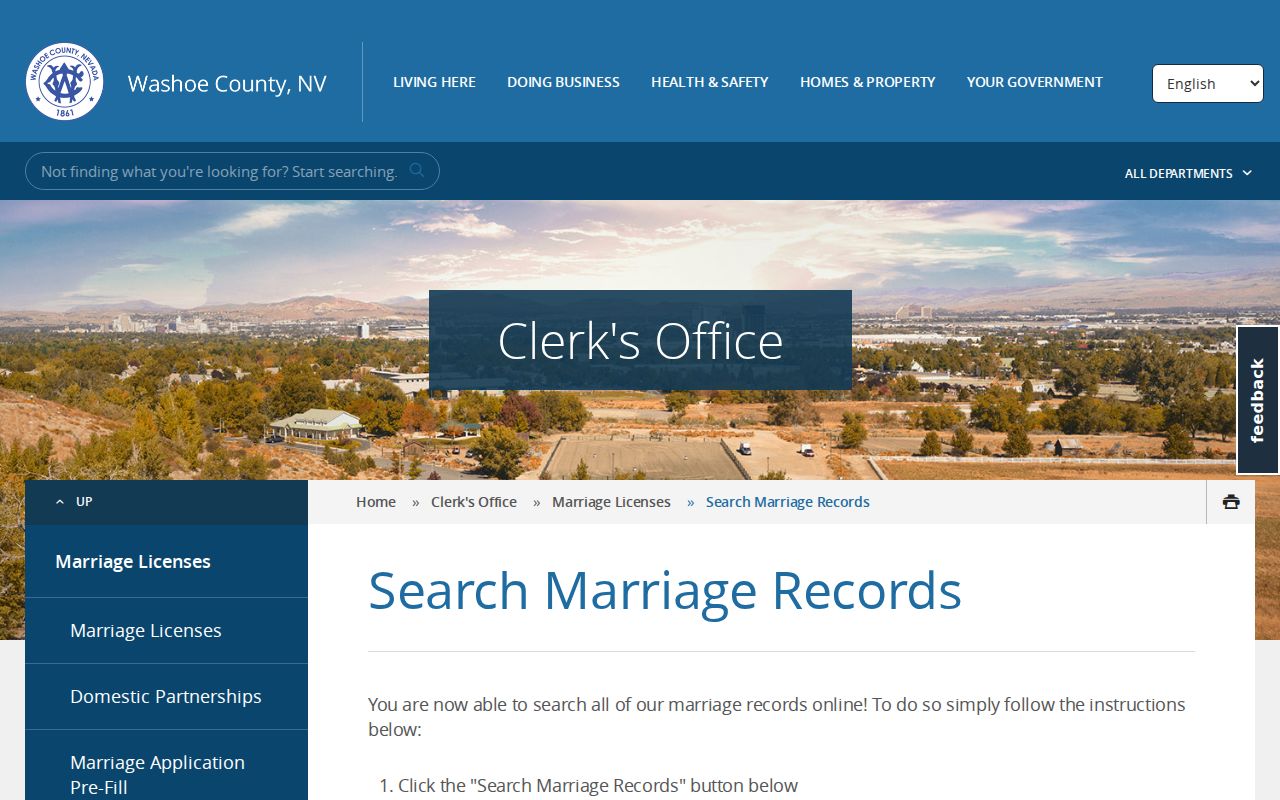
Used alongside directories and deeds, a marriage lead can refine a date range without being treated as an address or ownership record.
Reno House History Boundaries
Keep a dated log as the trail moves from CAMA to the Recorder, library, and archive. Note a no-result, unavailable image, unavailable volume, or changed street form as carefully as a match. Older records can be in books or microfiche; archive material can be fragile or subject to copying limits; and a web portal can have a login, access error, or different date cutoff. The cleanest historical address record reports those boundaries instead of hiding them.
For records held by a Reno or Washoe office outside a public portal, a focused request that names the record, date range, APN, document number, and delivery choice is more useful than a broad name search. Nevada's public-records starting point is NRS Chapter 239, but each custodian may have a different record series and access route.